
That baseline number surprises people the first time they hear it. One service a week sounds thin until you do the math: 10 users, 40 hours, one 60 to 70 gallon holding tank doing the work. Push past that user count and the interval has to tighten or the tank fills before the truck comes back. This is why a porta potty rental cost quote always starts with a headcount question, not a price question. Get the number wrong and you either overpay for empty capacity or run a unit into the ground three days before pickup.
How often should a porta potty be cleaned?
Once a week is the floor, not the target, for most jobs. A single standard porta potty rental serving 10 people across a 40 hour week matches the ANSI/PSAI Z4.3 service interval. Add more users, longer hours, or a Pittsburgh summer event and that interval has to shrink to twice or three times weekly.
Construction sites are the clearest case. OSHA 1926.51(c) sets the toilet count itself: one facility for 20 workers or fewer, one toilet seat and one urinal per 40 workers once you cross 20, and one per 50 once you hit 200 or more. That standard governs how many units you need, not how often each gets pumped, but the two numbers move together. A crew of 35 running a demolition job under a City of Pittsburgh Construction Staging Permit needs both the right unit count under OSHA portable toilet requirements and a tighter service schedule than a five person crew renting one porta john for a weekend.
Events compound the pressure. A single day at Point State Park or a weekend at Schenley Park during the Pittsburgh Vintage Grand Prix in July can push hundreds of people through units that were sized for a fraction of that traffic. That is why event restroom rental quotes for festival restroom rental jobs almost always include daily servicing, not weekly. If you are still working out unit count, start with how many porta potties do I need before you lock in a cleaning schedule around the wrong number.
What does a porta potty cleaning visit actually include?
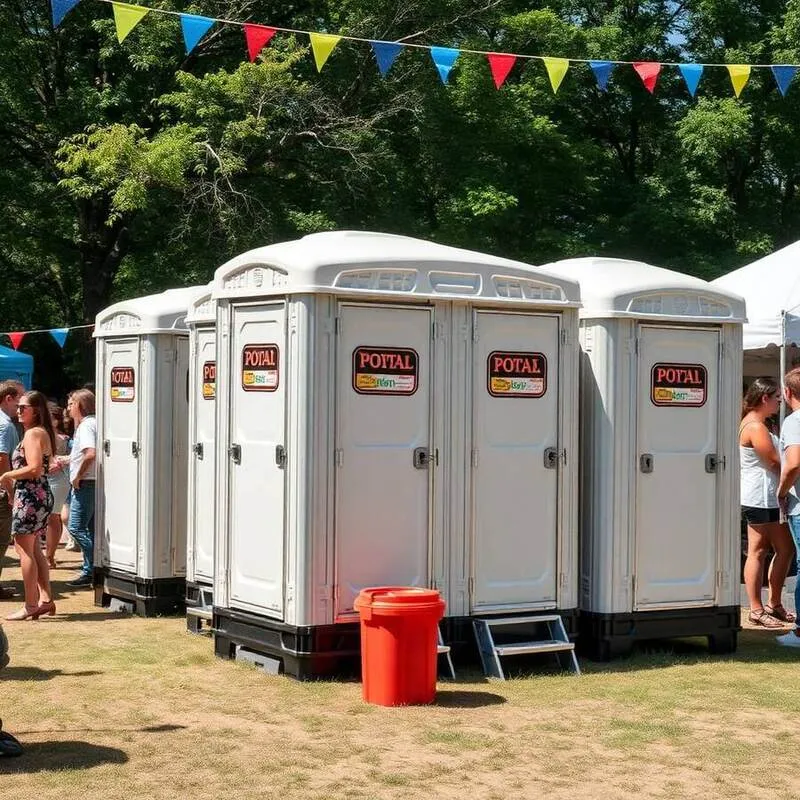
A service visit pumps the holding tank, refills the flush or deodorizer fluid, restocks paper, and wipes down the interior. It is not a deep clean every time; it is a reset so the unit stays usable until the next visit. Deluxe units with a flush mechanism, covered in deluxe flushable porta potty, get the same tank service plus a check on the water reservoir.
If someone searches "clean porta potty rental" or "self-cleaning porta potty rental," they are usually picturing a unit that never needs a truck to show up. That product does not really exist at the residential or job site scale we work at; every unit with a holding tank needs a physical pump-out on some interval, and the tank capacity, roughly 60 to 70 gallons on a standard unit, sets the outer limit on how long you can stretch between visits regardless of how it is marketed. What varies is how often that truck comes, and that is the number worth negotiating, not the marketing label on the unit.
For a fair comparison of how service frequency changes the bill, look at how pricing scales across durations:
| Rental length | Typical price range | Service visits included |
|---|---|---|
| Day | $100 - $350 | Usually none, drop and pickup only |
| Weekend | $125 - $400 | One visit at pickup, sometimes none |
| Week | $130 - $500 | One to two visits depending on traffic |
| Month | $125 - $325 | Weekly service standard, adjustable |
A porta potty rental per day booking for a single Saturday wedding rarely needs a mid rental service call. A monthly porta potty rental on a construction site almost always does, and that is where the ANSI/PSAI Z4.3 weekly floor becomes the contract default rather than an upper bound.
Why does Pittsburgh's terrain affect cleaning schedules?
Access is the hidden variable. Pittsburgh has more public staircases than any city in the country, and the City's own Citywide Steps Assessment counts more than 800 sets, some of them the legal street frontage for a property. If a service truck cannot reach a unit from the numbered street, the crew has to plan an alternate route or a different placement, and that changes how reliably a weekly visit happens on schedule. This matters most in the South Side Slopes, Oakland, Greenfield, the Hill District and Troy Hill, where the terrain is steepest.
Winter adds a second constraint. Pittsburgh averages 113.6 days a year at or below freezing and 44.1 inches of snow, with January alone averaging 13.3 inches. A frozen access road or an unplowed lot can delay a scheduled pump-out, which is exactly the scenario covered in porta potty in winter. Heat driven service arguments do not carry the same weight here; Pittsburgh only sees about 10 days a year above 90 F, so the busier season for tight cleaning schedules is event season and construction season, not summer heat itself.
Placement in the public right of way adds another layer. City Code Chapter 416, Section 416.01, requires a permit from DOMI before placing any obstruction in the public street or sidewalk, and no specific permit type is named for a standalone portable toilet, so confirm placement with the city before you set a unit where a service truck needs curb access. That question is covered in more depth on porta potty permit requirements and dumpster permit requirements for anyone running both a unit and a container on the same job.
If your unit sits somewhere a truck struggles to reach twice a week, an upgrade to a restroom trailer rental with larger holding capacity, like a 4 stall restroom trailer, can stretch the interval between visits without anyone noticing a gap in service.
Does hand sanitizer count as handwashing under OSHA?
No. 29 CFR 1910.141(d)(2) requires soap and towels or a hand drying device; hand sanitizer alone does not satisfy that rule. If your job involves paints, coatings, herbicides or insecticides, OSHA 1926.51(f)(1) requires washing facilities specifically for that contaminant exposure. See handwashing station requirements for the full breakdown.
How much does it cost to clean a porta potty outside a rental contract?
Standalone service calls are not typically sold separately from a rental; cleaning is bundled into the day, weekend, week, or month rate. A weekly rental running $130 to $500 already includes one to two visits. Ask about your specific job through request a quote rather than pricing a cleaning visit in isolation.
Can I request extra cleanings mid rental?
Yes. Most rentals, including portable toilet rental and portable restroom rental agreements, allow added service visits for a fee if usage runs heavier than expected. Flag high traffic events like a marathon leg near Acrisure Stadium or a multi-day build near Oakland's hospital construction early so the schedule gets built in rather than added last minute.
Do ADA accessible units get cleaned on the same schedule?
Yes, ADA units follow the same interval as standard units on a given job. Under ADA Standards section 213.2, at least 5 percent of clustered units, and never fewer than one, must be accessible, and that unit gets serviced on the same rotation as the rest. Details are on ADA accessible porta potty.
What happens if a unit is not cleaned on schedule during winter?
Freezing temperatures can slow decomposition and increase odor once temperatures rise again, and a missed visit during a snow event is more likely given Pittsburgh's 44.1 inch average snowfall. Confirm a weather contingency plan when booking; see porta potty in winter for how routes get adjusted.
Is a septic holding tank serviced on the same schedule as a porta potty?
No. A residential septic tank is typically pumped every 3 to 5 years depending on tank size and household use, a much longer interval than a rented unit's weekly cycle. See how often to pump a septic tank for that comparison, or holding tank rental if you need a standalone tank rather than a full toilet unit.
Can I find portable toilet cleaning jobs or service work through Pittsburgh Porta Pros?
This page covers rental service schedules for customers, not hiring. For sourcing a unit, servicing, or event package anywhere from Downtown Pittsburgh out to Monroeville 14.3 miles east or Bethel Park 11.3 miles south, start with contact or browse service areas.
Next step
Get a delivery date
Tell us the address, the dates and the headcount. We size the order and confirm the route.