
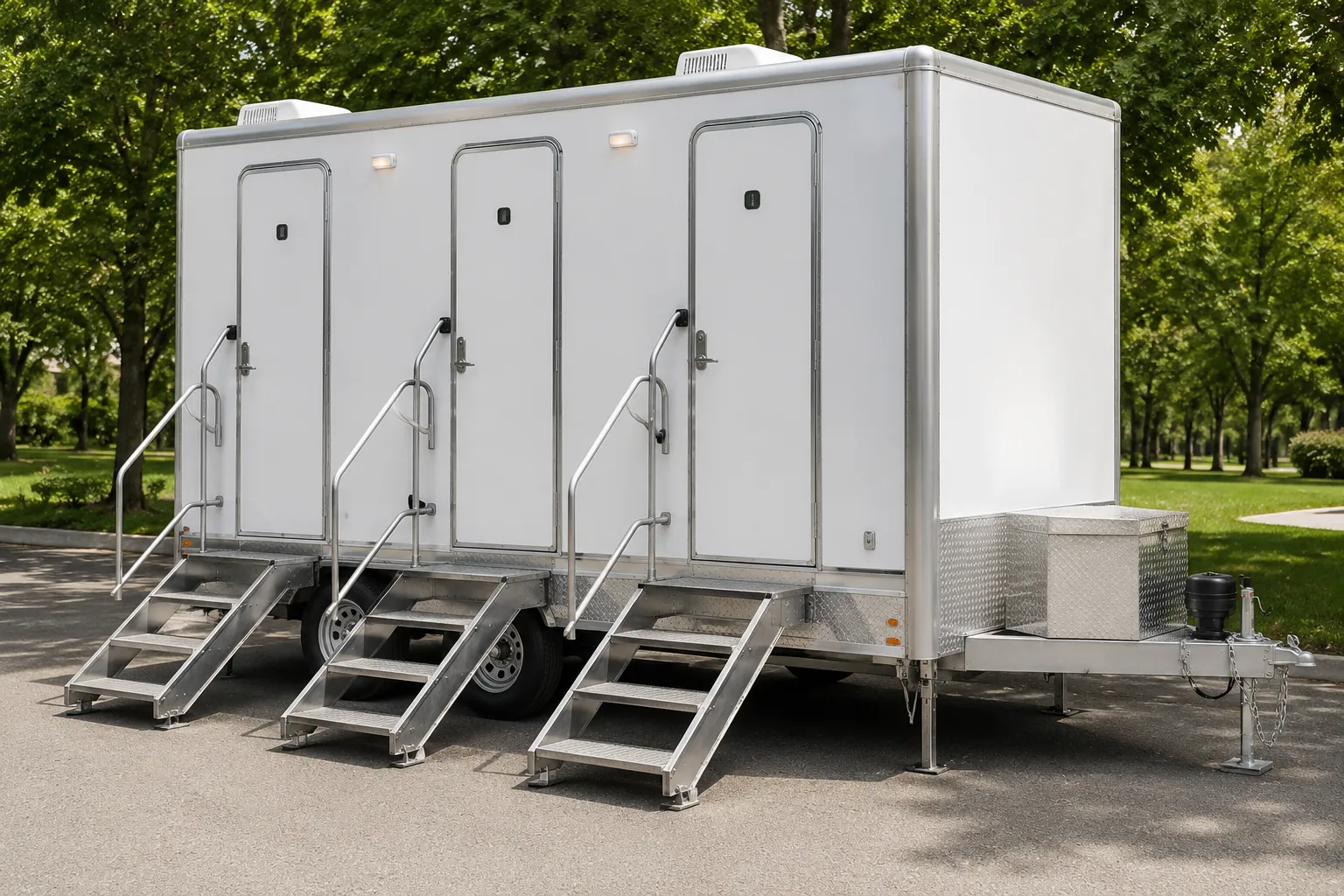
Most people searching "restroom trailer rental near me" are picturing something between a job site porta john and a wedding venue bathroom. A restroom trailer sits in the middle. It has real stalls, running water, and climate control, and it works for weddings at wedding restroom rental sites, construction jobs that need more than a standard porta potty rental, and festivals that draw crowds bigger than a backyard party. If you are still deciding between a trailer and a straight portable toilet rental, the headcount and the event length usually decide it for you.
What is a restroom trailer, exactly?
A restroom trailer is a towable unit built with separate stalls, flushing toilets, sinks with running water, and often climate control, mounted inside an enclosed trailer body. It is not a portable toilet on wheels. Compare that to a deluxe flushable porta potty, which flushes but stays a single-occupant unit, or a standard porta potty rental with a 60 to 70 gallon holding tank and no plumbing at all.
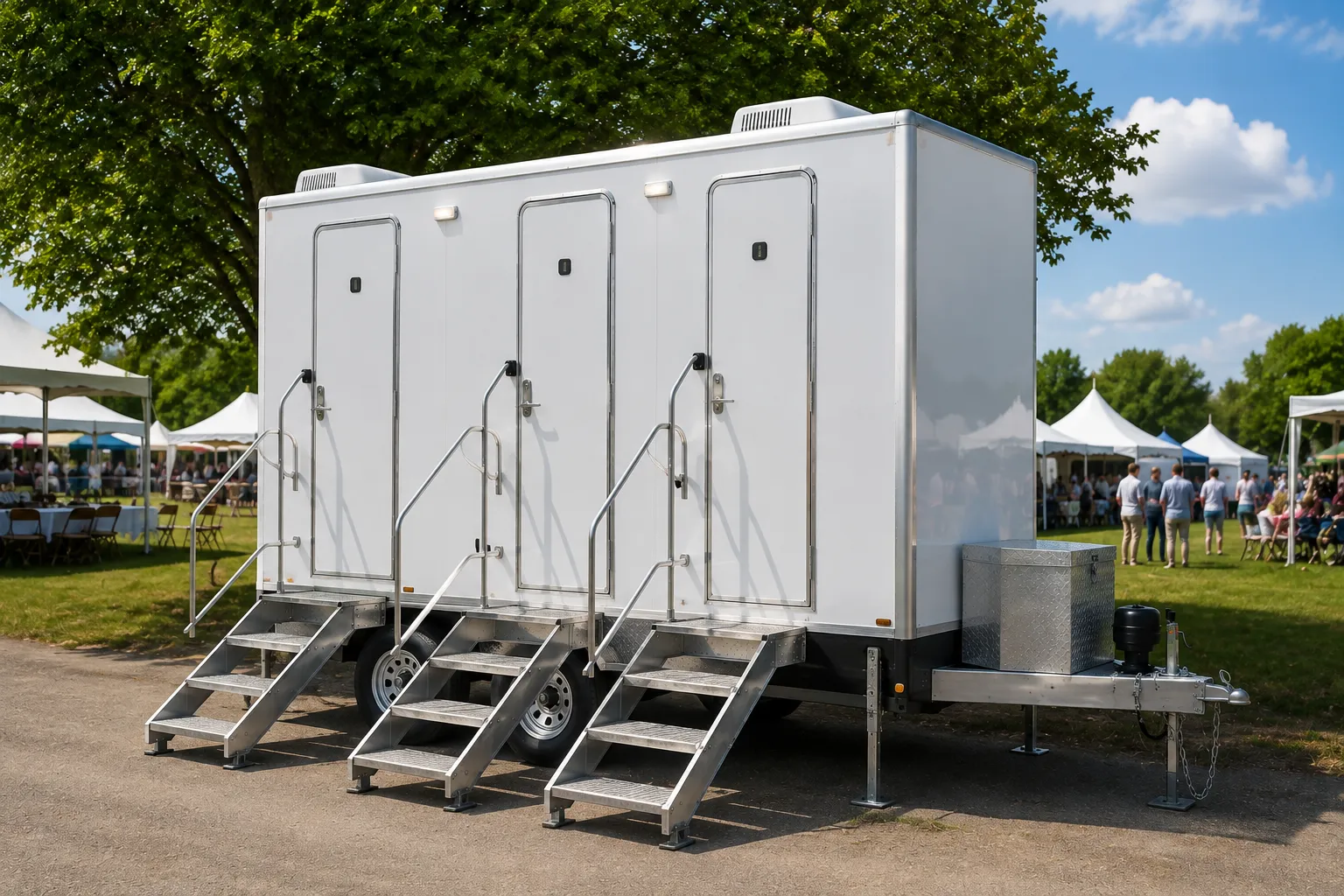
Inside a restroom trailer you get individual stalls with doors, a bank of sinks, mirrors, and usually lighting and ventilation that run off a generator or shore power. Some units step up further into a luxury restroom trailer with finished interiors, and some markets call the high end a luxury portable restroom trailer rental, same product, different phrasing. If your event needs actual showers instead of just toilets, that is a separate category covered under shower trailer rental, often paired with a restroom trailer rental at the same site for multi-day festivals or disaster response work under disaster relief sanitation.
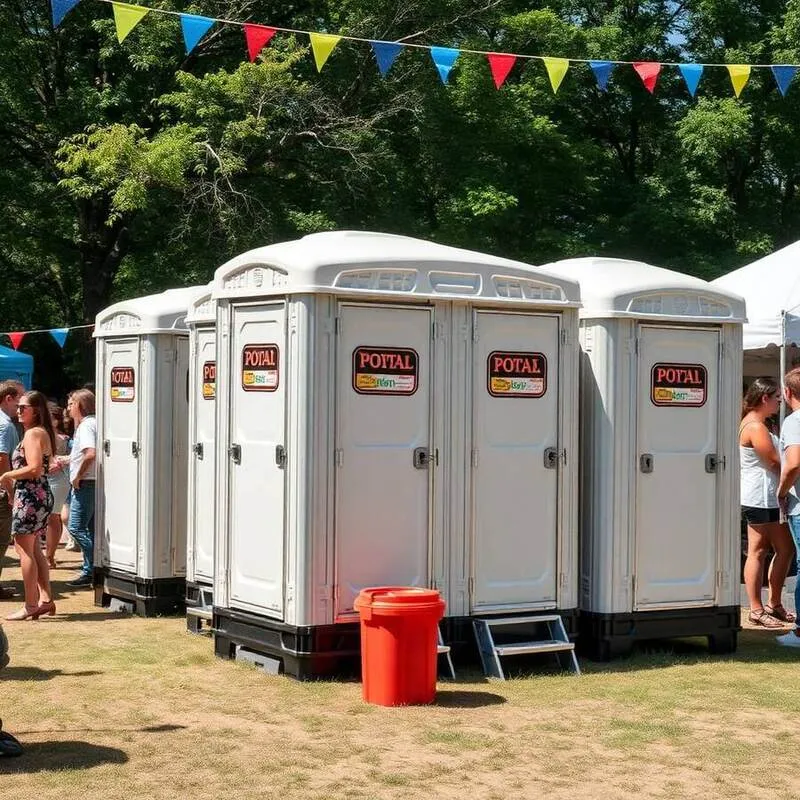
How many stalls do I need?
Stall count comes down to headcount and event length, not just guest count on an invitation. A 2 stall restroom trailer covers small backyard weddings or short crew jobs under 50 people. A 4 stall restroom trailer handles mid-size weddings, corporate picnics, and construction crews in the 50 to 150 range. An 8 stall restroom trailer is built for festivals, large weddings, or multi-day events pulling several hundred guests, and pairs well with extra units from event restroom rental planning.
Construction sites have a harder rule to follow. OSHA 1926.51(c)(1) sets the ratio at one toilet facility per 20 workers or fewer, one toilet seat and one urinal per 40 workers once you pass 20, and one seat and one urinal per 50 workers at 200 or more. A general contractor running a 60-person crew in Oakland, where Pitt's Campus Recreation and Wellness Center and Arena and Sports Performance Center projects have been announced at 250 million and 240 million dollars respectively, needs to run that math against a mixed bag of trailers and standard units, not guess. For the full breakdown by crew size, see how many porta potties do I need and OSHA portable toilet requirements.
| trailer size | typical use | rough weekend cost |
|---|---|---|
| 2 stall | small wedding, small crew | 900 to 2000 |
| 4 stall | mid-size event, larger crew | 900 to 2000 |
| 8 stall | festival, large wedding | 2499 to 3899 (event rate) |
Those figures come from measured rental data across 799 datapoints, and they move with duration. A single-day trailer rental can run anywhere from 175 to 2500 dollars depending on size and finish level, while a full week runs from around 150 up to 1650. For the fuller cost breakdown by duration and stall count, see restroom trailer rental cost and, for comparison against standard units, porta potty rental cost.
Restroom trailer rental cost in Pittsburgh
Pricing depends on trailer size, rental length, and how far the delivery truck has to travel. A weekend trailer rental in Pittsburgh, measured across the broader dataset, lands between 900 and 3000 dollars, while a full event-length booking, the kind you would book for a multi-day festival, runs from about 2499 up to 3899 dollars. Daily rentals swing widest, from 175 dollars for a bare-bones unit up to 2500 for a fully finished luxury trailer.
| duration | low | typical | high |
|---|---|---|---|
| day | 175 | 800 | 2500 |
| weekend | 900 | 2000 | 3000 |
| week | 150 | 1397 | 1650 |
| event | 2499 | 3500 | 3899 |
Delivery is usually billed separately and depends on distance and access. A standard delivery fee runs 100 to 500 dollars for a single day, or 50 to 150 for a full week, on top of the trailer rate itself. If your site sits outside the Pittsburgh core, distance matters: Mount Lebanon is 7.0 miles southwest, Shaler is 8.2 miles north, Ross is 8.8 miles northwest, and Bethel Park runs 11.3 miles south. Farther out, McCandless sits 12.0 miles north, Penn Hills 12.3 miles east, Monroeville 14.3 miles east, and North Huntingdon 17.6 miles southeast. All of those pull a standard delivery fee; check service areas for a full list, or look at dedicated pages like porta potty rental in Mount Lebanon or porta potty rental in Monroeville if your event sits closer to one of those towns.
Can a restroom trailer go anywhere in Pittsburgh?
Not automatically, and Pittsburgh's terrain makes this a real question instead of a formality. The city has a dedicated H Hillside zoning district, a Landslide Prone Overlay, and an Undermined Area Overlay reflecting historic coal mining beneath parts of town, so ground stability is not a given everywhere. Roughly 450 sets of the city's more than 800 sets of public steps are built on structures the City compares to small bridge projects, and in neighborhoods like the South Side Slopes, Oakland, Greenfield, the Hill District, and Troy Hill, a property's legal street frontage can be a staircase rather than a driveable surface. That means a trailer, like a roll-off truck under roll-off dumpster rental, sometimes cannot reach the address it is numbered on, and site access has to be checked before delivery day, not on it.
If your event or job sits in the public right of way, obstructions require a permit from DOMI, the City of Pittsburgh Department of Mobility and Infrastructure, under City Code Chapter 416, Section 416.01. That rule is written for anything obstructing a street or sidewalk, and while no specific DOMI permit type is named for a standalone trailer or portable toilet the way there is for a demolition dumpster, the general obstruction rule still applies if you are placing a unit off private property. We recommend confirming placement with DOMI before delivery if your site touches the sidewalk or curb lane at all. For dumpster-specific permit detail, which follows a clearer named process through OneStopPGH, see dumpster permit requirements and porta potty permit requirements.
Private property, backyards, parking lots, and fields do not carry that same right-of-way question, which is why most weddings booked through event restroom rental or venues like Hartwood Acres and Point State Park, a 36 acre Pennsylvania DCNR park with its own Special Event Guidelines, plan trailer placement on the grounds themselves rather than the street.
Do restroom trailers need ADA accessible units too?
Yes, when the event or job site otherwise requires accessible portable sanitation. Where single-user portable toilet units are clustered, ADA Standards section 213.2 requires at least 5 percent of the cluster to be accessible, and never fewer than one unit. A restroom trailer with individual stalls is often treated similarly on larger events, pairing an ADA accessible porta potty unit alongside the trailer bank rather than building an accessible stall into the trailer itself, since trailer interiors are usually too narrow to meet a 60 inch turning circle under ADA section 304.3.1.
Access to that unit matters as much as its presence. ADA section 403.5.1 sets a 36 inch minimum clear width for the accessible route leading to it, and section 404.2.3 requires a 32 inch clear door opening. Ground has to be stable and slip-resistant under section 302.1, which on a construction site or a sloped Pittsburgh lawn is not automatic. Full detail on stacking an ADA unit with a trailer setup lives at ADA restroom requirements.
What about handwashing and water supply?
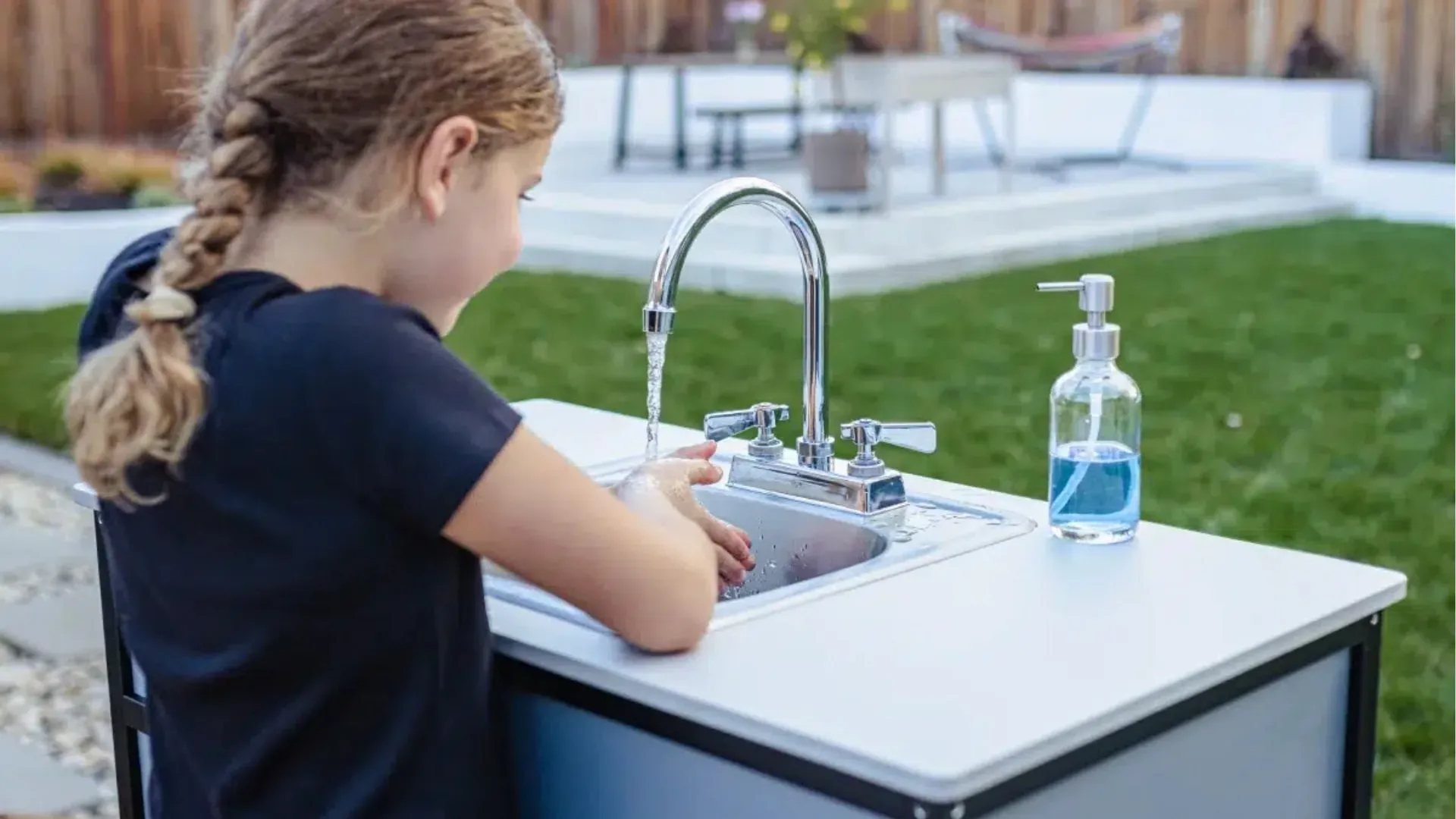
A restroom trailer includes sinks, but larger events sometimes add standalone stations anyway to spread out lines. OSHA 1926.51(a)(1) requires an adequate supply of potable water at all places of employment, and general industry washing rules under 29 CFR 1910.141(d)2) call for soap and towels or a hand-drying device; hand sanitizer alone does not satisfy that. If your crew is doing any work with paints, coatings, herbicides, or insecticides, OSHA 1926.51(f)(1) requires washing facilities specifically for that contaminant exposure, separate from the general sanitation rule. See handwashing station rental and handwashing requirements for the fuller breakdown, or portable sink rental if you just need extra sinks near a food line.
Winter and weather in Pittsburgh
Pittsburgh averages 44.1 inches of snow a year and about 113.6 days at or below freezing, with a January average low of 21.4 degrees. That is a real service consideration for any trailer with plumbing, since standing water lines can freeze solid overnight without proper insulation or heat trace. Pittsburgh Porta Pros winterizes trailers for cold-season bookings, and the topic gets a full page at porta potty in winter. On the other end, the city sees only about 10.1 days a year at or above 90 degrees, so heat is a minor factor compared to freeze planning here.
Booking a trailer for your event or job
Weddings, festivals, and marathons all book trailers differently than a construction site does. A wedding at a private venue usually books through wedding restroom rental with a single weekend window. A race like Pittsburgh Marathon Weekend, organized by P3R each May, needs units placed along a route rather than at one static address, covered at marathon and race restrooms. Festivals such as Picklesburgh or the Dollar Bank Three Rivers Arts Festival, both held Downtown and at Arts Landing in the Cultural District, need higher stall counts concentrated in a smaller footprint, closer to festival restroom rental territory, and concerts at Acrisure Stadium or the Hartwood Acres amphitheater lean on concert restroom rental planning instead.
Construction jobs run longer and need steadier service intervals. ANSI/PSAI Z4.3 sets a baseline service interval of one visit per week for up to 10 users over a 40 hour week, which is the standard we plan around for job site trailers and standard units alike, whether it is a single construction dumpster rental site or a full buildout under construction site services. If you are still weighing a trailer against straight units for a renovation, home renovation porta potty walks through that comparison directly.
To get a number for your specific stall count, event length, and Pittsburgh address, request a quote or check contact for direct scheduling. Pittsburgh Porta Pros can also bundle a trailer with temporary fence rental for event perimeter control or a storage container rental for equipment on longer jobs.
How far in advance should I book a restroom trailer?
Book as early as you have a date, especially for weekend weddings and summer festivals. Trailer inventory is smaller than standard porta potty inventory, and popular weekends near Schenley Park or Point State Park events get reserved months out. For jobs with a firm start date, book alongside your temporary fence rental or dumpster order so delivery windows line up.
What is the difference between a 2 stall and 4 stall restroom trailer?
A 2 stall trailer suits groups under about 50 people over a short window, like a small backyard wedding. A 4 stall trailer handles 50 to 150 guests or a mid-size crew and holds up better over a full weekend. Both come from the same weekend price band, 900 to 2000 dollars, so the choice usually comes down to expected line length, not cost.
Does a restroom trailer need a generator?
Many do, unless shore power is available on site. Trailers with lighting, climate control, and water pumps typically run on a generator or a dedicated circuit, and that needs to be scoped before delivery. If your event also runs lighting equipment, pairing with a light tower rental or temporary power pole on the same order simplifies power planning.
Can I put a restroom trailer on a city street in Pittsburgh?
Only with a permit. Anything obstructing the public right of way in Pittsburgh needs authorization from DOMI under City Code 416.01, and the Director can deny a permit under 416.02(a) if it would interfere with traffic flow or create a dangerous condition. Private property, lots, and venue grounds avoid this step entirely, which is why most trailer bookings default there.
How much does a luxury restroom trailer cost compared to a standard one?
Luxury and deluxe trailers cost more per day than a bare stall trailer, with daily rates for higher-finish units running toward the 800 to 2500 dollar range compared to lower rates for basic setups. The finish level, not just stall count, drives most of that gap. See luxury restroom trailer for what separates the tiers.
Do restroom trailers work for construction sites, or just events?
Both. Construction crews use trailers when headcount or job length makes a bank of standard units impractical, and OSHA 1926.51(c)(1) still governs the ratio of facilities to workers regardless of whether those facilities are trailers or standard units. Long-term jobs sometimes mix a trailer with several standard porta potty rental units to hit the ratio affordably.
Next step
Get a delivery date
Tell us the address, the dates and the headcount. We size the order and confirm the route.