
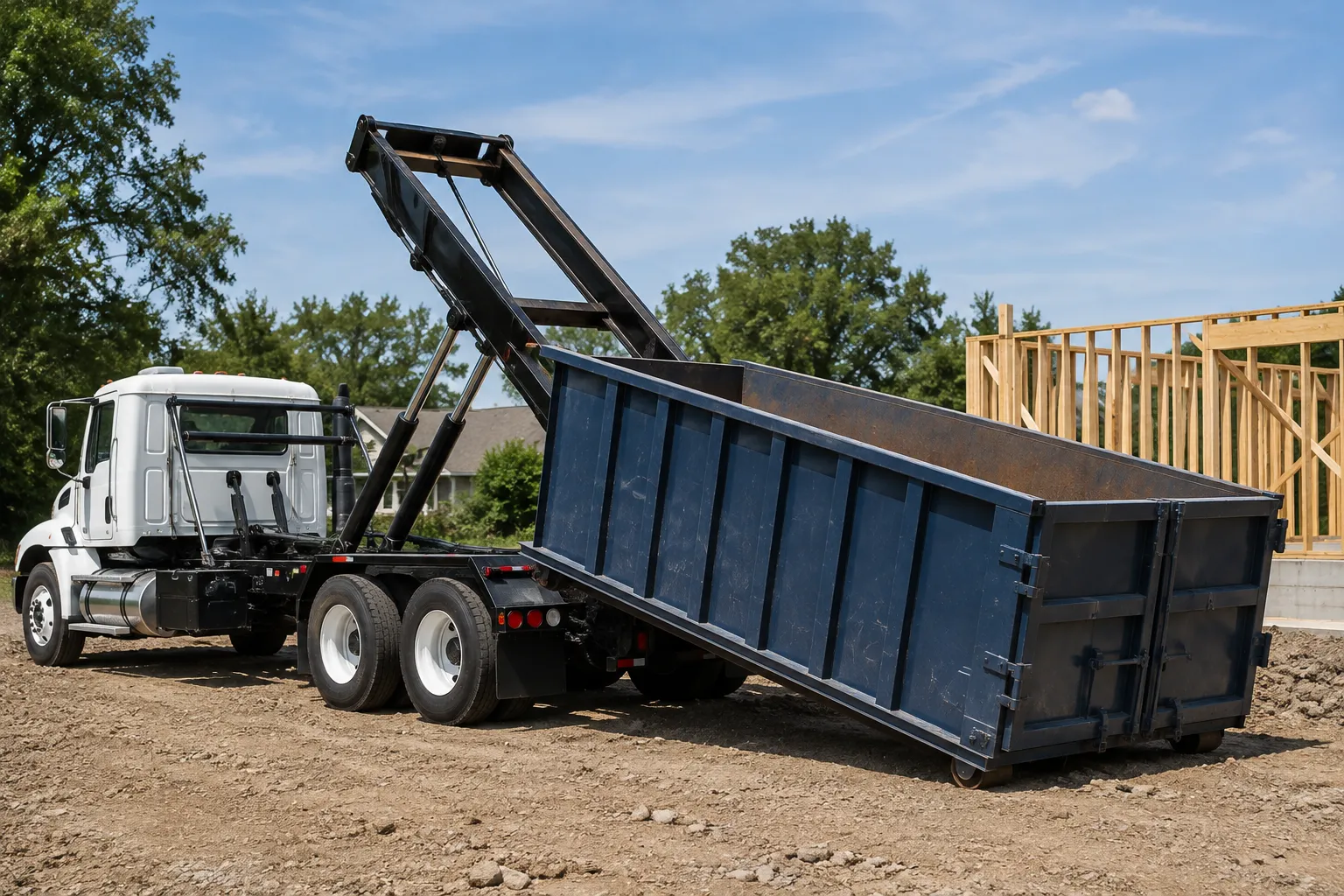
If you have ever stood in a driveway trying to guess whether a 10 yard or a 20 yard roll off dumpster rental will actually swallow your garage cleanout, you are not alone. Pittsburgh's terrain and its permit rules both push people toward the wrong size more often than you'd think. This page walks through what each size actually holds, what it weighs when it's full, what you can't throw in it, and what the City of Pittsburgh wants from you before the truck ever shows up, similar to the questions we answer on dumpster rental per day style pricing pages for toilets. For general pricing across every unit type, see dumpster rental cost in Pittsburgh.
What Size Roll-Off Dumpster Do I Need?
Most homeowners need a 10 or 20 yard dumpster; most contractors clearing a full house or a mid-size job need a 30 or 40 yard box, much like sizing a portable toilet rental for a crew. Size depends on volume, not weight alone, and Pittsburgh's hillside lots and narrow streets add a wrinkle: what fits on paper doesn't always fit on the block.
- 10 yard - garage cleanout, small bathroom demo, a couple rooms of flooring. See 10 yard dumpster rental.
- 20 yard - kitchen remodel, roof tear-off on a mid-size house, basement cleanout. This is the size most people mean when they search 20 yard dumpster rental or 20 yd roll off dumpster rental. Details at 20 yard dumpster rental.
- 30 yard - whole-house decluttering, new construction debris, larger additions. See 30 yard dumpster rental.
- 40 yard - commercial demolition, large renovation projects, high-volume construction sites. See 40 yard dumpster rental.
If none of those descriptions quite match your project, the full breakdown of dimensions and typical loads is on dumpster sizes and dimensions, and our general construction site services page covers how dumpsters fit alongside fencing, storage and toilets on an active job. For anyone still torn between two sizes, it's almost always cheaper to size up once than to order a second haul, the same logic that applies when picking between a porta john rental and a larger restroom setup.
Roll-Off Dumpster Rental Price
| unit | duration | low | typical | high |
|---|---|---|---|---|
| dumpster | day | 51 | 75 | 112 |
| dumpster | weekend | 390 | 440 | 497 |
| dumpster | week | 426 | 600 | 778 |
| dumpster | month | 91 | 108 | 500 |
| delivery_fee | day | 100 | 150 | 500 |
| delivery_fee | week | 50 | 100 | 150 |
These bands come from measured pricing across the market, not a quote for your specific address. Weekend rates run higher than a single weekday because most weekend jobs are compressed timelines with less flexibility for the hauler, similar to weekend pricing patterns on event restroom rental. A week always costs more than a day, and a month always costs more than a week, but the per-day rate drops the longer you keep the box. Delivery is usually billed separately from the rental itself, and in Pittsburgh that delivery fee sometimes has to cover more than mileage; if your street requires a City permit or a metered parking space, that gets folded in too. For a full cost walkthrough with more line items, see dumpster rental cost in Pittsburgh. If your project spans multiple weeks, ask about switching from weekly to monthly billing once you're past the two-week mark, since the crossover point is where monthly starts to make sense, the same crossover we cover on monthly porta potty rental.
Roll Off Dumpster Rental Near Me: What Pittsburgh's Terrain Means for Delivery
A roll-off delivery needs about 60 feet of straight clearance behind the truck to back in and drop the container safely. That's easy on a suburban driveway. It's a real problem on a lot of Pittsburgh streets.
Pittsburgh has more public staircases than any other city in the country. The City's own Citywide Steps Assessment counts more than 800 sets of city steps, containing more than 45,000 individual steps, and states plainly that these steps are part of the right-of-way network. In neighborhoods like the South Side Slopes, Oakland, Greenfield, the Hill District and Troy Hill, a property's legal frontage can be a staircase rather than a driveable street. That means a roll-off truck sometimes can't reach the address from the street it's numbered on, and you need to talk delivery logistics with us before you book, not after the truck is already stuck at the bottom of the hill.
The city's hillside geography also shows up in the zoning code itself. Pittsburgh has a dedicated H Hillside base zoning district, plus a Landslide Prone Overlay and an Undermined Area Overlay reflecting old coal mining beneath parts of the city. None of that stops a dumpster delivery outright, but it's part of why we ask about your specific block before confirming a drop date, the same reason we ask before dropping a restroom trailer rental on a tight street. If your project sits in Mount Lebanon, about 7.0 miles southwest of downtown, or out in Bethel Park at 11.3 miles south, street layouts tend to be more forgiving than the dense hillside neighborhoods closer to the core. Jobs in Monroeville, 14.3 miles east, or North Huntingdon, 17.6 miles southeast, usually have suburban-style driveways with no clearance issues at all, and both towns are on our porta potty rental Monroeville, PA and porta potty rental North Huntingdon, PA service lists.
Does Pittsburgh Require a Permit for a Roll-Off Dumpster?
Yes, for demolition work. A dumpster placed in the public right of way in Pittsburgh needs a permit from DOMI, the Department of Mobility and Infrastructure, under City Code Title Four, Article I, Chapter 416, Obstructions. Section 416.01 states that before anyone places an obstruction in the right of way, a permit must first be obtained from the Director.
For demolition jobs specifically, the named permit is the Construction Staging Permit, Demolition Dumpster work type, applied for through the OneStopPGH portal. It's good for up to 42 days, and DOMI's own guidance says a demolition dumpster should sit in a parking lane whenever possible. Once it's on site, the approved DOMI permit has to be attached to the dumpster facing the sidewalk, legible from the street. Base fees run 135 dollars at application plus 60 dollars at issuance, with a 40 dollar extension fee if you need more time, a 280 dollar major obstruction fee for permits longer than 18 days, and a 30 dollar per two-week fee if you're on a primary road or in a business district. If your spot is metered, you'll also need to contact the Pittsburgh Parking Authority directly and pay meter fees. A No Parking sign issued with the permit has to go up at least 48 hours before your permit period starts, and DOMI can cite and fine you if the container sits in the right of way after the permit expires.
Non-demolition dumpster placements run on a different track: DOMI requires a Furnishing Plan Review for temporary or movable objects in the right of way, and that process also requires listing the City as additional insured. Section 416.04 defines a temporary traffic obstruction broadly, covering any activity that interferes with normal right-of-way operations, including private construction that spills onto the sidewalk or street. Under 416.02(a), the Director can deny a permit outright if the obstruction would materially interfere with traffic flow, create a dangerous condition, or threaten public health or safety. Full detail on the process is on dumpster permit requirements, and if your project sits entirely on private property, on your own driveway or lot, none of this applies. Check porta potty permit requirements too if you're renting a toilet alongside the dumpster, since Pittsburgh treats that as a separate obstruction question that isn't fully spelled out for standalone units.
Also worth knowing: there's a moratorium on permanent sidewalk and street restoration from November 1 through March 31 each year in Pittsburgh, and steel plating placed during that window has to be coordinated with snow plowing. If your project runs into winter, factor that into your timeline. More on cold-weather logistics generally is on porta potty in winter, and general seasonal planning fits with what we cover on emergency porta potty rental for storm and disaster response jobs, see also disaster relief sanitation.
What Can't Go in a Roll-Off Dumpster?
Most residential and construction debris is fine: wood, drywall, flooring, roofing shingles, furniture, general trash. What's not fine, across nearly every hauler and every landfill, includes tires, batteries, paint cans with liquid still in them, motor oil, refrigerants, asbestos, and anything classified as hazardous waste. Electronics are often restricted too, depending on the load.
Allegheny County's two main landfills, Imperial Landfill and Monroeville Landfill, together take in close to 700,000 tons of waste annually, according to the county's 2019 Municipal Solid Waste Management Plan Update. Four disposal facilities operate in the county under that plan: Imperial, Kelly Run Sanitation, Monroeville and South Hills. The Allegheny County Health Department's Solid Waste Division inspects roughly 40 facilities and around 400 solid waste vehicles a year, so what goes into your dumpster does get checked against what's allowed. A full list of restricted items and why they matter is on what cannot go in a dumpster, and OSHA's housekeeping standard at 1926.25 requires that scrap and debris be cleared from work areas on active job sites, which is part of why dumpsters get placed close to the work rather than at the property line.
What Are Roll-Off Dumpster Weight Limits?
Every size comes with a weight limit built into the rental, and going over it means an overage charge, billed per ton past the cap. Heavier materials like concrete, brick, dirt and shingles fill a dumpster's weight allowance fast even when the box still looks half empty, which is the single biggest reason people get surprised by an overage fee. A 20 yard box full of roofing shingles will hit its weight limit long before it hits its volume limit; a 20 yard box full of old furniture and cardboard usually won't come close. If you're not sure which category your job falls into, tell us the materials when you book and we'll steer you toward the right size instead of the wrong one. Specific weight limits by dumpster size, along with how overage billing works, are laid out on dumpster weight limits.
Roll Off Dumpster Rental for Construction Sites
Construction jobs in Pittsburgh generate a lot of dumpster demand. The City issued 9,158 permits in 2025 with a combined declared project value of 1,633,336,703 dollars, including 4,133 Building and Development Applications and 139 demolition permits, the exact permit type tied to the demolition dumpster process described above. Much of the institutional construction driving that volume sits in Oakland, including a UPMC bed tower announced at 1.5 billion dollars and 900,000 square feet, a Pitt Campus Recreation and Wellness Center announced at 250 million dollars, and a Pitt Arena and Sports Performance Center announced at 240 million dollars. Those figures reflect what was announced, not necessarily what's under construction today, but they show the scale of work generating debris across the city.
On active construction sites, a dumpster is one piece of a larger sanitation and safety picture. OSHA 1926.51(c) sets toilet facility ratios for construction workers, requiring at least one toilet for crews of 20 or fewer, with more facilities added as headcount grows. OSHA 1926.404(b)(1)(ii) covers GFCI protection for temporary power on site, and OSHA 1926.202 requires barricades on site to meet ANSI D6.1 for worker protection, both worth knowing if you're setting up a full site plan. For sites juggling dumpsters, fencing and restrooms together, construction site services walks through how those pieces fit, and temporary fence rental covers perimeter security around an active dumpster or work zone. If your project also needs crowd or pedestrian control near the dumpster, see crowd control barrier rental, and a chain link temporary fence works well for securing the perimeter around the box itself.
Larger renovation and demolition jobs also tend to need on-site storage. If you're pulling fixtures or materials out faster than they're getting hauled, a storage container rental or a 20ft storage container parked next to the dumpster keeps salvageable material separate from debris. And any site running through Pittsburgh's roughly 114 annual freeze days and 44.1 inches of average yearly snowfall, per NOAA's 1991-2020 Climate Normals for Pittsburgh International Airport, should plan dumpster placement with plowing and ice in mind, not just summer access, and consider a handwashing station rental alongside it for crews working through winter.
How Do I Book a Roll-Off Dumpster in Pittsburgh?
Call, request a quote online, or fill out our request a quote form with your address, project type and rough timeline. We'll tell you which size fits, flag if your street needs a DOMI permit, and get you a delivery window. For most residential jobs we can turn around delivery quickly; for demolition work requiring a City permit, build in a few extra days for the OneStopPGH application and the required 48-hour No Parking posting.
If you're outside city limits, we also serve Shaler at 8.2 miles north, Ross at 8.8 miles northwest, McCandless at 12.0 miles north, and Penn Hills at 12.3 miles east, along with the rest of our service areas. Each of those towns has its own permit rules that differ from the City of Pittsburgh's, so tell us your municipality when you book. General information about our company is on about, and if you have questions before requesting a quote, contact us directly or check the frequently asked questions page.
Frequently Asked Questions
How much does a roll off dumpster rental cost in Pittsburgh?
Daily rates typically run 51 to 112 dollars, weekly rates run 426 to 778 dollars, and monthly rates run 91 to 500 dollars depending on size and how long you need it. Delivery is usually billed separately, often 50 to 150 dollars for a weekly rental. See dumpster rental cost for a full breakdown by size.
What size dumpster do I need for a kitchen remodel?
Most kitchen remodels fit a 20 yard dumpster, which handles cabinets, countertops, flooring and drywall from a mid-size kitchen. Larger remodels with structural work or an open floor plan sometimes need a 30 yard box. See 20 yard dumpster rental for specifics.
Do I need a permit for a dumpster in my own driveway?
No. Pittsburgh's DOMI permit requirement under City Code 416.01 applies to obstructions in the public right of way, meaning the street or sidewalk. A dumpster placed entirely on your own driveway or private property doesn't trigger that permit process.
Can a roll-off truck reach my house in a hillside neighborhood?
Not always. A roll-off delivery needs about 60 feet of straight clearance behind the truck, and in neighborhoods like the South Side Slopes or Troy Hill, a property's legal frontage can be a staircase rather than a driveable street. Tell us your address before booking so we can check access.
What happens if I go over the weight limit?
You'll be billed an overage fee per ton past the container's weight cap, which is set separately from its volume. Heavy materials like concrete, shingles or dirt hit the weight limit fast even in a partly empty dumpster. See dumpster weight limits for limits by size.
How long can I keep a roll-off dumpster in Pittsburgh's right of way?
The Construction Staging Permit for demolition dumpsters allows placement for up to 42 days, with a 40 dollar extension fee available if you need more time. Longer permits, over 18 days, carry an additional 280 dollar major obstruction fee under DOMI's fee schedule.
What can't I put in a roll-off dumpster?
Hazardous materials are off limits everywhere: paint with liquid still in the can, motor oil, batteries, tires, refrigerants and asbestos. Most general construction debris, furniture and household trash is fine. Full list on what cannot go in a dumpster.
Next step
Get a delivery date
Tell us the address, the dates and the headcount. We size the order and confirm the route.